What is the difference between SEO, AEO, GEO, and LEO?
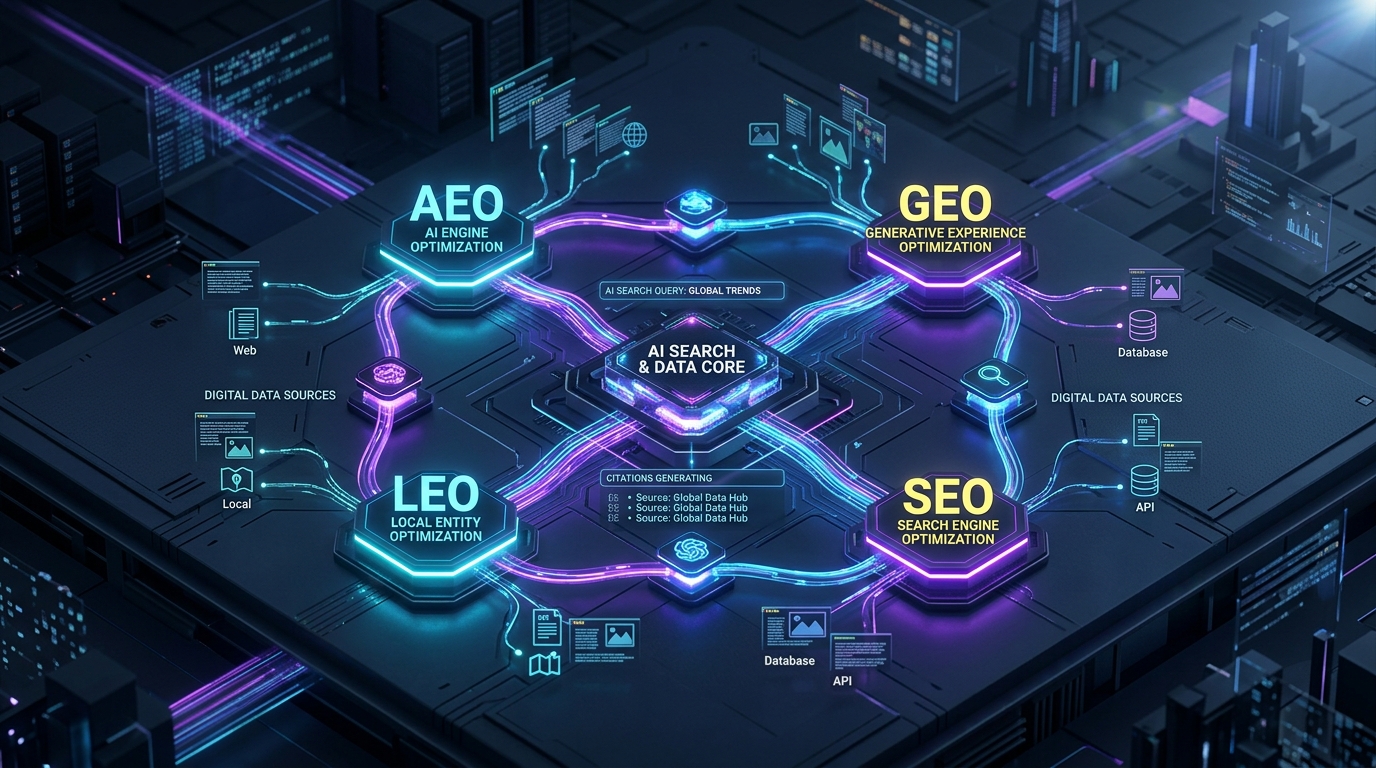
SEO (Search Engine Optimization) ranks URLs in traditional keyword-based crawlers like Google; AEO (Answer Engine Optimization) formats direct factual answers for zero-click AI engines like Perplexity and voice assistants; GEO (Generative Engine Optimization) structures verifiable entity knowledge graphs and statistical citations so LLMs (ChatGPT, Claude, Gemini) cite your brand during conversational synthesis; and LEO (Latent Engine Optimization) optimizes high-dimensional vector embeddings and semantic cluster proximity so your content matches user search intent across latent neural retrieval spaces.
If you are a founder, marketer, or customer support leader looking at your web analytics in late 2026, you have almost certainly noticed the shift: organic search impressions are staying steady or growing, but organic click-through rates (CTR) on informational queries have dropped by 30% to 55%.
The reason is simple: users are no longer clicking through ten blue links to manually read through five different articles. They are querying Perplexity, ChatGPT Search, Claude, and Google AI Overviews to get synthesized, conversational answers in seconds.
If your website and support documentation are only optimized for 2018-era keyword stuffing, your brand is effectively invisible in these AI responses. To thrive in 2026, you must orchestrate four interlocking optimization pillars: SEO, AEO, GEO, and LEO.
The 4 Search Optimization Paradigms Compared
Here is how the search landscape has transformed from traditional keyword matching to multi-dimensional latent entity retrieval:
Pillar 1: Technical & Content SEO in 2026 (The Essential Foundation)
Contrary to hyperbolic claims that “SEO is dead,” traditional SEO is more critical than ever—because AI engines use search crawlers as their raw data ingestion pipeline. If your website has crawl errors, orphaned pages, or slow server response times, LLMs will never index your content in their RAG memory in the first place.
In 2026, baseline technical SEO requires:
- Instant Real-Time IndexNow Integration: When you update a product pricing tier, customer policy, or blog post, ping IndexNow immediately so Bing, Copilot, and Yandex re-crawl within minutes rather than weeks.
- Sub-200ms Server TTFB (Time to First Byte): AI bots have strict fetch timeouts. Fast servers ensure crawler workers don’t drop your pages during batch indexing.
- Clean XML Sub-Sitemaps: Segment your pages into distinct sitemaps (e.g.,
sitemap-pages.xml,sitemap-features.xml,sitemap-solutions.xml, andsitemap-landing.xml) so crawlers can prioritize high-intent commercial routes. - Hierarchical Breadcrumbs: Explicit breadcrumb schema informs search crawlers of your site architecture and thematic clusters.
Pillar 2: AEO (Answer Engine Optimization) — Winning the Zero-Click SERP
Answer engines like Perplexity, Microsoft Copilot, and Apple Siri do not want 3,000 words of introductory storytelling before getting to the answer. They employ extraction pipelines designed to isolate unambiguous, authoritative factual statements.
The 60-Word “Direct Answer” Rule
For every major query you target, format your H2 or H3 heading as a natural user question (e.g., “How does a shared WhatsApp team inbox prevent duplicate replies?”). Immediately below that heading, provide a direct, grammatically complete answer between 45 and 65 words before diving into nuanced details.
This allows Answer Engine tokenizers to lift your exact phrasing as the primary featured snippet or synthesized speech reply.
Structured FAQPage & HowTo JSON-LD Schemas
Always accompany your high-intent pages with valid FAQPage schema markup. Here is the exact JSON-LD format that search engines use to populate conversational answer cards:
{
  "@context": "https://schema.org",
  "@type": "FAQPage",
  "mainEntity": [{
    "@type": "Question",
    "name": "Can multiple agents share one WhatsApp Business number?",
    "acceptedAnswer": {
      "@type": "Answer",
      "text": "Yes. Using a shared team inbox like Thunaivi connected to the official Meta Cloud API, multiple support agents can simultaneously reply from one verified WhatsApp number with real-time collision detection."
    }
  }]
}
Pillar 3: GEO (Generative Engine Optimization) — How to Get Cited in ChatGPT & Claude
Generative Engine Optimization is the science of making large language models select your brand as a trusted citation when answering broad, complex prompts (such as “What are the best customer support software tools for ecommerce in 2026?”).
Academic research published by Princeton University, Georgia Tech, and Allen AI demonstrated that traditional SEO factors like keyword frequency had minimal impact on LLM visibility. Instead, the following factors yielded up to a +40% increase in generative citations:
1. Verifiable Data & Statistics
LLMs heavily favor sources that cite verifiable quantitative benchmarks (e.g., “lowers repetitive inquiries by 80%” or “achieves sub-2s response speed”) over qualitative generic statements.
2. Entity Grounding & Knowledge Graphs
Anchor your brand alongside recognized industry entities (e.g., WhatsApp Business API, Zendesk, Intercom, WooCommerce) so embedding models calculate strong entity affinity.
3. Transparent Pricing & Feature Tables
AI models avoid recommending software with hidden pricing or gated demo-only walls. Transparent pricing tiers make your platform readily extractable for buyer comparisons.
When you build dedicated comparison pages (like our Thunaivi vs Zendesk or Freshdesk Alternative guides), use tabular data matrices. LLM retrieval transformers parse structured HTML tables significantly faster and with higher fidelity than long prose.
Pillar 4: LEO (Latent Engine Optimization) — Winning High-Dimensional Vector Search
Modern search engines and enterprise AI assistants increasingly rely on Dense Vector Retrieval. Instead of looking for identical word strings, the engine passes the user’s prompt through an embedding model (like OpenAI text-embedding-3, Cohere embed-v3, or Google Gecko), producing a 1,536-dimensional or 3,072-dimensional vector.
The system then performs a cosine similarity calculation against indexed web content chunks. To win at Latent Engine Optimization (LEO):
- Maximize Semantic Density: Eliminate fluff, generic corporate pleasantries, and keyword stuffing. Every sentence should introduce a distinct technical concept, capability, or user outcome.
- Build Tight Topical Clusters: Avoid sprawling 10,000-word mega-guides that touch on twenty unrelated subjects. Instead, create modular, interlinked topical hubs where each URL focuses purely on one semantic intent (e.g., WhatsApp customer support, shared team inbox, or ecommerce WhatsApp automation).
- Optimize for High Cosine Affinity: Align your page vocabulary with the exact problem statements your buyers use in natural conversations (e.g., “agents talking over each other in WhatsApp”, “customer chats getting lost on one phone”).
The Secret Weapon: Your Customer Support Transcripts & Knowledge Base
Here is an insight that 95% of software companies overlook: your customer support conversations are your most valuable generative search asset.
When customers ask questions in your website chat or WhatsApp channel, they are expressing real-world user intent in raw, unedited natural language. If you capture these inquiries and turn them into public-facing knowledge base articles, FAQ entities, and localized city hubs (like our Bangalore and London support hubs), you create a self-reinforcing flywheel:
Real customer chats on WhatsApp → Automated deflection by Thunaivi AI → Identified unhandled FAQ gaps → Public structured FAQ publishing → Ingestion by Perplexity & ChatGPT Search → Inbound generative referral traffic & qualified leads.
The 2026 Search Dominance Checklist
Before publishing your next major page or product update, verify your checklist against the four pillars:
- ✓ [SEO] Instant IndexNow push configured for Bing, Copilot, and Yandex.
- ✓ [SEO] Clean XML sitemap hierarchy submitted to Google Search Console and Bing Webmaster.
- ✓ [AEO] Question-formatted H2/H3 headings with 50-word direct answer summaries directly underneath.
- ✓ [AEO] Valid
FAQPageandServiceJSON-LD schema injected into the document head. - ✓ [GEO] Verifiable data points, percentage metrics, and benchmark comparisons included in table format.
- ✓ [GEO] Clear entity relationships linking your brand to known industry standards and tools.
- ✓ [LEO] High semantic density throughout all body paragraphs with zero filler content.
- ✓ [LEO] Deep contextual internal links to related topic cluster articles and product tools.
Ready to Dominate AI Search & Automate Your Customer Support?
Run a free audit on our interactive SEO + AEO + GEO + LEO Lead Engine or test how much your team can save using our Support ROI Calculator.